Apple Watch Sleep Score: What It Measures and How to Read It
 By Martin, Astrea co-founder
When our baby arrived, my nights came apart. I started checking my Apple Watch every morning with two questions. How much of the night was I awake? And what was that doing to my training?
The watch sums up each night in one number, the Sleep Score. Some nights look like this one, from 2 November: 12 minutes awake and a little over seven hours asleep. Others come in more pieces. Here’s what goes into the score, what its labels mean and how to read yours.
Quick digest
- The Sleep Score runs from 0 to 100, split three ways (Apple Inc., n.d.-a): how long you slept (50 points), how regular your bedtime is (30) and how much you woke up (20).
- Each score gets a label. Since watchOS 26.2, a 75 reads OK. Before the update, the same 75 read High (MacRumors, 2025).
- Your own recent weeks tell you more than the label does.
- The chart behind the score, a hypnogram, shows your night in rounds of about 90 minutes: deep sleep early, more REM toward morning.
How to read the sleep chart
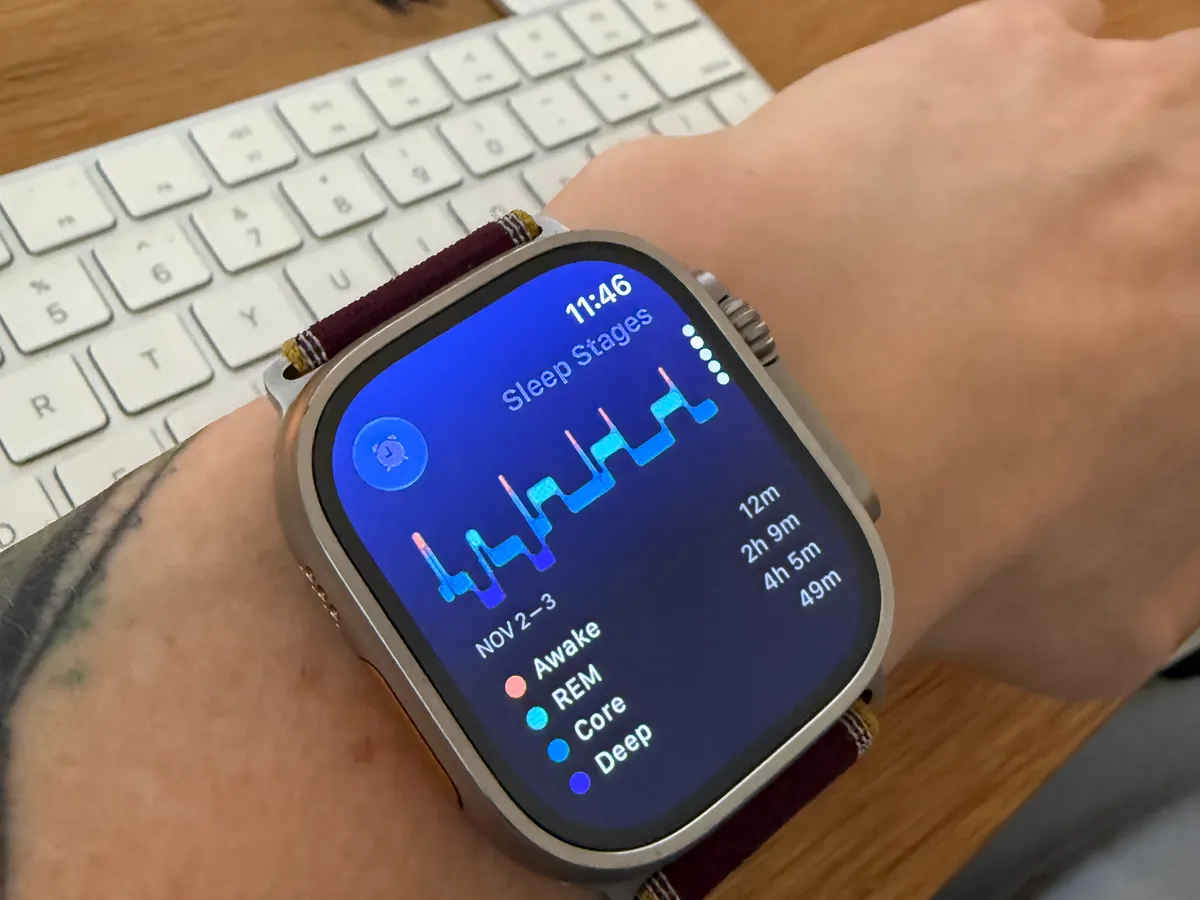
Behind the score sits a chart. The Sleep app draws your night as a hypnogram: a stepped line that moves between sleep stages from falling asleep to waking up. Time runs left to right. The photo above shows my night of 2 November on the watch. The Health app on iPhone draws the same night larger, with each row labelled: 7 hours 3 minutes asleep, and a red spike in the Awake row for each of the five times I woke.
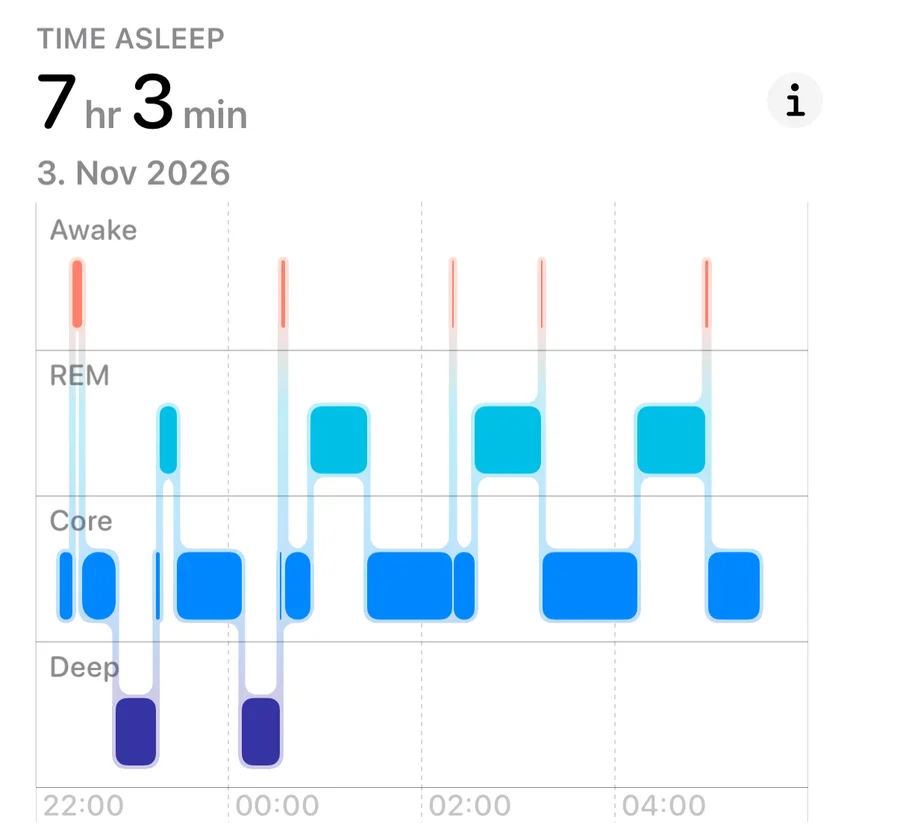
Each row is a stage (Apple Inc., 2025):
- Awake is the top row. Each spike up here is a moment you woke, and these are what the score’s waking-up part counts.
- REM is the stage where your eyes move quickly, your breathing changes and your brain activity looks close to awake.
- Core is Apple’s name for light sleep, the clinical stages N1 and N2. It usually fills more than half the night.
- Deep is slow-wave sleep, clinical stage N3.
A night runs in rounds. You cycle through the stages four to six times, about 90 minutes a round (Patel et al., 2024). Deep sleep crowds into the early rounds, and REM grows longer toward morning (Carskadon & Dement, 2017). So a night cut short at the end mostly costs you REM. My night follows that shape. Both blocks of deep sleep come before half past midnight, and a block of REM returns about every hour and a half until morning.
Where the points come from
Apple publishes the split between the three parts. The exact cut-offs inside each part stay private, so anyone quoting them online is guessing.
Sleep length, 50 points. Half your score is how long you slept. US sleep experts recommend at least seven hours a night for adults (Watson et al., 2015), and the National Sleep Foundation puts the range at seven to nine for ages 18 to 64 (Hirshkowitz et al., 2015).
Bedtime, 30 points. The watch looks at when you fell asleep on each of the last 13 nights (Apple Inc., n.d.-a). A steady bedtime earns points on its own, however long the night. Researchers measure something broader: a sleep regularity index, covering when you sleep and wake. In one study of 61 students over a month, the least regular sleepers had body clocks running about two and a half hours later than the most regular ones, and they tended to get lower grades (Phillips et al., 2017). In about 61,000 middle-aged and older adults in the UK, sleep regularity predicted the risk of dying during the study better than sleep length did (Windred et al., 2024). Both studies show a link and leave open which way it runs.
Waking up, 20 points. This part counts how often you woke and for how long (Apple Inc., n.d.-b). For a new parent, it’s the one that takes the hit. By the National Sleep Foundation’s measure, good sleep in adults means at most one wake-up longer than five minutes, and 20 minutes or less awake in total once you’ve first dropped off (Ohayon et al., 2017). My 12 minutes on 2 November came in under that.
What a broken night does to your training
This was my real question. In lab studies where researchers broke up people’s sleep but kept the total hours the same, people were sleepier the next day, reacted more slowly and made more mistakes, much as if they’d lost the hours (Stepanski, 2002). New parents show the same thing. In one study, first-time mothers and fathers were sleepier by day than couples without a baby (Insana & Montgomery-Downs, 2013).
Most exercise studies take sleep away rather than break it up. For broken nights, they’re still the closest guide we have. One review found the clearest hit on long, steady efforts, and the same work felt harder (Fullagar et al., 2015). A later analysis of 69 studies found drops in every kind of exercise it looked at, short hard efforts and strength included (Craven et al., 2022). Nine in ten of the people in them were men.
A night of feeds can add up to decent hours on paper and still come in pieces. Going by that evidence, training will likely feel harder the next day, long sessions most of all.
Why your score dropped
If your label slipped after an update, your sleep may be the same. The labels moved. watchOS 26.2 raised every band and renamed the top one from Excellent to Very High (MacRumors, 2025). Apple’s guide for watchOS 27 still lists the new bands (Apple Inc., n.d.-a).
| Band | Since 26.2 | Before 26.2 |
|---|---|---|
| Very Low | 0–40 | 0–29 |
| Low | 41–60 | 30–49 |
| OK | 61–80 | 50–69 |
| High | 81–95 | 70–89 |
| Very High | 96–100 | 90–100 |
Same night, same 75: it used to read High, and now it reads OK. So follow the number, and set it against your own last few weeks.
What the score misses
Every point rests on one estimate: when you were asleep and when you were awake. Apple tested its newest version against lab sleep recordings. It now gets time awake right 79 percent of the time, up from 70, and agrees fairly well with the lab on sleep stages (Apple Inc., 2025). Time awake is the hard part for other trackers too. In a test of seven other consumer trackers, most spotted sleep well, missed more of the time awake and did worse again on disrupted nights (Chinoy et al., 2021).
The score also leaves out how you feel. If you wake up fine after a 68, trust that too.
And watch out for chasing it. Sleep researchers have described people who slept worse while trying to improve their tracker’s numbers, and named it orthosomnia (Baron et al., 2017).
If your score stays low for weeks and you’re sleepy during the day, see a doctor. The watch describes your night. A doctor can find out why.
How Astrea reads the same night
We built Astrea, our app, to compare each night with your own. It takes the same Apple Watch data from Apple Health and gives the night a score out of 100, plus one word: Restless, Steady or Restorative.
The yardstick is your own full night: the length you reach on a good night, taken from your last 28. For the technically minded, that’s the 75th percentile, held between six and nine hours. After about three weeks of short nights, it shifts toward the nights you’re having, and the six-hour floor keeps a long run of short nights from passing as enough. Each night’s score then feeds Recovery, Astrea’s morning score.
If you’d like each night compared with your own good ones, Astrea is on the App Store.
What to do
- Look at the whole week. Check your last seven nights before you react to one. The Sleep page in the Health app has a week view (Apple Inc., n.d.-b).
- Find the part that cost you. Tap the score to see all three parts. Short hours and a lot of waking have different causes, and call for different changes.
- Hold your bedtime steady. It’s worth 30 points, and in a week of short nights it’s often the part you can still control.
- Wear it to bed, charged. The score needs Track Sleep with Apple Watch turned on and at least an hour of wear (Apple Inc., n.d.-b).
- Ease off after short nights. After a run of short or interrupted nights, training will likely feel harder, long steady sessions most of all (Fullagar et al., 2015). Save the hard sessions for when the nights settle.
FAQ
Where do I find my Apple Watch Sleep Score? On the watch, open the Sleep app after you wake up. On iPhone, open the Health app, tap Browse, then Sleep (Apple Inc., n.d.-a; Apple Inc., n.d.-b).
What is a good Sleep Score on Apple Watch? By Apple’s bands, 81 to 95 is High and 96 or more is Very High (Apple Inc., n.d.-a). For you, a good score is one at or above your usual.
Why did my Sleep Score drop after an update? watchOS 26.2 raised every band. A night that scored 75 used to read High and now reads OK (MacRumors, 2025).
Can I get a Sleep Score on iPhone alone? The Sleep Score needs an Apple Watch. Apple asks for Track Sleep with Apple Watch turned on, and the watch worn for at least an hour of the night (Apple Inc., n.d.-b). On its own, the iPhone runs your sleep schedule, your wake-up alarm and Sleep Focus.
Why is my score different from Oura or Whoop? Each company builds its score its own way, from different sensors. Apple Watch, for example, estimates sleep stages from its motion sensor (Apple Inc., 2025). So the same night gets different numbers. Compare each device with itself over time.
Sources
Apple Inc. (n.d.-a). View your Sleep Score on Apple Watch. Apple Watch User Guide. https://support.apple.com/guide/watch/apded441a669/watchos
Apple Inc. (n.d.-b). Track your sleep on Apple Watch and use Sleep on iPhone. Apple Support. https://support.apple.com/en-us/108906
Apple Inc. (2025). Estimating sleep stages from Apple Watch [White paper]. https://www.apple.com/health/pdf/Estimating_Sleep_Stages_from_Apple_Watch_Oct_2025.pdf
Baron, K. G., Abbott, S., Jao, N., Manalo, N., & Mullen, R. (2017). Orthosomnia: Are some patients taking the quantified self too far? Journal of Clinical Sleep Medicine, 13(2), 351–354. https://doi.org/10.5664/jcsm.6472
Carskadon, M. A., & Dement, W. C. (2017). Normal human sleep. In M. Kryger, T. Roth, & W. C. Dement (Eds.), Principles and practice of sleep medicine (6th ed., pp. 15–24.e3). Elsevier. https://doi.org/10.1016/B978-0-323-24288-2.00002-7
Chinoy, E. D., Cuellar, J. A., Huwa, K. E., Jameson, J. T., Watson, C. H., Bessman, S. C., Hirsch, D. A., Cooper, A. D., Drummond, S. P. A., & Markwald, R. R. (2021). Performance of seven consumer sleep-tracking devices compared with polysomnography. Sleep, 44(5), zsaa291. https://doi.org/10.1093/sleep/zsaa291
Craven, J., McCartney, D., Desbrow, B., Sabapathy, S., Bellinger, P., Roberts, L., & Irwin, C. (2022). Effects of acute sleep loss on physical performance: A systematic and meta-analytical review. Sports Medicine, 52(11), 2669–2690. https://doi.org/10.1007/s40279-022-01706-y
Fullagar, H. H. K., Skorski, S., Duffield, R., Hammes, D., Coutts, A. J., & Meyer, T. (2015). Sleep and athletic performance: The effects of sleep loss on exercise performance, and physiological and cognitive responses to exercise. Sports Medicine, 45(2), 161–186. https://doi.org/10.1007/s40279-014-0260-0
Hirshkowitz, M., Whiton, K., Albert, S. M., Alessi, C., Bruni, O., DonCarlos, L., Hazen, N., Herman, J., Katz, E. S., Kheirandish-Gozal, L., Neubauer, D. N., O’Donnell, A. E., Ohayon, M., Peever, J., Rawding, R., Sachdeva, R. C., Setters, B., Vitiello, M. V., Ware, J. C., & Adams Hillard, P. J. (2015). National Sleep Foundation’s sleep time duration recommendations: Methodology and results summary. Sleep Health, 1(1), 40–43. https://doi.org/10.1016/j.sleh.2014.12.010
Insana, S. P., & Montgomery-Downs, H. E. (2013). Sleep and sleepiness among first-time postpartum parents: A field- and laboratory-based multimethod assessment. Developmental Psychobiology, 55(4), 361–372. https://doi.org/10.1002/dev.21040
MacRumors. (2025, November 4). iOS 26.2 and watchOS 26.2 update Sleep Score ranges. https://www.macrumors.com/2025/11/04/watchos-26-2-updates-sleep-score-ranges/
Ohayon, M., Wickwire, E. M., Hirshkowitz, M., Albert, S. M., Avidan, A., Daly, F. J., Dauvilliers, Y., Ferri, R., Fung, C., Gozal, D., Hazen, N., Krystal, A., Lichstein, K., Mallampalli, M., Plazzi, G., Rawding, R., Scheer, F. A., Somers, V., & Vitiello, M. V. (2017). National Sleep Foundation’s sleep quality recommendations: First report. Sleep Health, 3(1), 6–19. https://doi.org/10.1016/j.sleh.2016.11.006
Patel, A. K., Reddy, V., Shumway, K. R., & Araujo, J. F. (2024). Physiology, sleep stages. In StatPearls. StatPearls Publishing. https://www.ncbi.nlm.nih.gov/books/NBK526132/
Phillips, A. J. K., Clerx, W. M., O’Brien, C. S., Sano, A., Barger, L. K., Picard, R. W., Lockley, S. W., Klerman, E. B., & Czeisler, C. A. (2017). Irregular sleep/wake patterns are associated with poorer academic performance and delayed circadian and sleep/wake timing. Scientific Reports, 7, 3216. https://doi.org/10.1038/s41598-017-03171-4
Stepanski, E. J. (2002). The effect of sleep fragmentation on daytime function. Sleep, 25(3), 268–276. https://doi.org/10.1093/sleep/25.3.268
Watson, N. F., Badr, M. S., Belenky, G., Bliwise, D. L., Buxton, O. M., Buysse, D., Dinges, D. F., Gangwisch, J., Grandner, M. A., Kushida, C., Malhotra, R. K., Martin, J. L., Patel, S. R., Quan, S., & Tasali, E. (2015). Recommended amount of sleep for a healthy adult: A joint consensus statement of the American Academy of Sleep Medicine and Sleep Research Society. Sleep, 38(6), 843–844. https://doi.org/10.5665/sleep.4716
Windred, D. P., Burns, A. C., Lane, J. M., Saxena, R., Rutter, M. K., Cain, S. W., & Phillips, A. J. K. (2024). Sleep regularity is a stronger predictor of mortality risk than sleep duration: A prospective cohort study. Sleep, 47(1), zsad253. https://doi.org/10.1093/sleep/zsad253
A note from us We’re Martin and Marina, Astrea’s co-founders. We’re both into data and serious about our own training, but neither of us is a doctor or a clinical researcher. The health and physiology claims in this article come from published, peer-reviewed research, not our own expertise, which is why every article ends with a Sources list above. If a claim doesn’t trace back to a real source, we cut it before it gets published.
Astrea is built for the long game — recovery and readiness tracking that adapts as your training, and your body, changes over the years.


Related reading · See all Sleep, Recovery & Longevity