How Your Menstrual Cycle Affects HRV, Sleep, and Recovery
 By Marina, Astrea co-founder Substack
Before I was pregnant, when my cycle was still regular, I could feel the difference in my training from one week to the next without looking at a single number. Some weeks a hard interval session felt like it belonged to me. Other weeks the same session felt like wading through sand, and my sleep was lighter even though nothing else in my life had changed. I actually came to this whole idea sideways, through the more spiritual framing of cyclical living rather than sports science: the idea that a woman’s month has seasons, not a flat line. It was only later that I started asking whether any of that showed up in my own training data, and it did.
Quick digest
- Heart rate variability (HRV) tends to be lower in the second half of your cycle (the luteal phase) than in the first half (the follicular phase), tracking closely with rising progesterone (Schmalenberger et al., 2020).
- Progesterone raises your core body temperature by roughly 0.3-0.5°C (0.5-0.9°F) after ovulation and flattens the natural nighttime temperature drop your body uses to fall and stay asleep (Baker et al., 2020; Grant et al., 2020).
- Resting heart rate measured by wearables runs about 3-5% higher in the luteal phase than in the mid-follicular phase, a real physiological shift, not something you’re imagining (Goodale et al., 2019).
- Lab sleep recordings show more light sleep and more brief arousals in the luteal phase, even in women who don’t consciously feel like their sleep got worse (Driver et al., 1996).
- In athletes, how you actually feel (symptoms like cramping, low mood, or poor sleep) tracks recovery more closely than which cycle day you’re on or your raw hormone levels, so your own read is at least as useful as the calendar (Pearson et al., 2025).
The two hormones doing the work
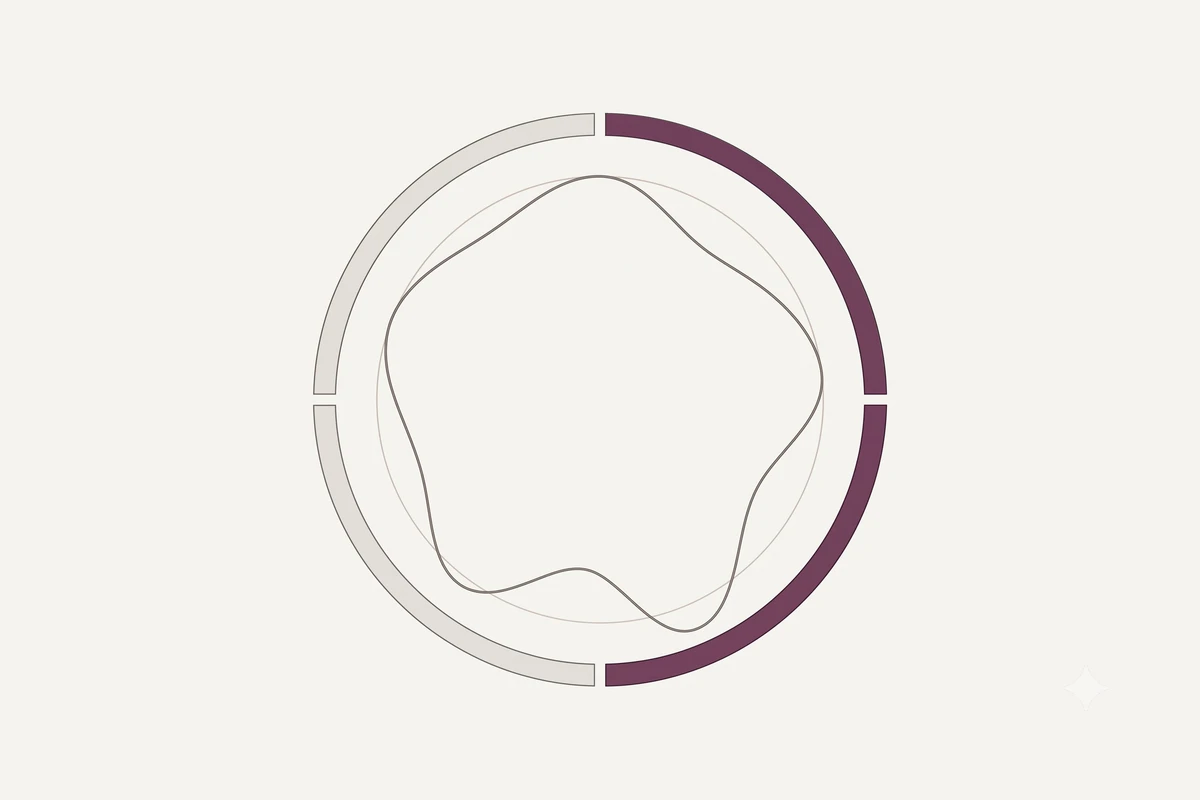
A menstrual cycle runs on two main hormones that rise and fall in a predictable order, and most of what shows up in your HRV and sleep data traces back to one of them.
The first half of the cycle, the follicular phase, starts on the first day of your period and runs until ovulation. Estrogen rises steadily through this window while progesterone stays low. The second half, the luteal phase, starts right after ovulation and lasts until your next period. Progesterone rises sharply here, alongside a smaller second rise in estrogen, then both drop off in the days before your period starts, which is when premenstrual symptoms tend to cluster.
Progesterone is the one to watch if you’re trying to make sense of a recovery app. It doesn’t just prepare the body for a possible pregnancy. It also acts on the autonomic nervous system and on the part of the brain that controls body temperature, which is why its rise in the luteal phase shows up so clearly in HRV, resting heart rate, and sleep data (Baker et al., 2020; Schmalenberger et al., 2020).
Why HRV dips in the second half of your cycle
HRV, or heart rate variability, measures the variation in time between consecutive heartbeats. A higher number generally reflects a nervous system that’s leaning toward rest and recovery (the parasympathetic, or “vagal,” branch); a lower number reflects more activation from the stress-and-effort branch (the sympathetic branch).
Across the menstrual cycle, vagally-mediated HRV is highest in the follicular phase and drops during the mid-to-late luteal phase. Two within-person studies found that this pattern tracked progesterone specifically: on days when a person’s progesterone was higher than their own usual level, their HRV was lower than their own usual level, on that same day (Schmalenberger et al., 2020). Estrogen didn’t show the same relationship. This matters because it means the dip isn’t a vague “hormonal” effect, it’s tied to one specific, measurable hormone doing a specific job.
The same pattern shows up outside the lab. An analysis of wearable data from thousands of real menstrual cycles found resting heart rate almost 5% lower in the mid-follicular phase than in the luteal phase, a shift large enough to register as nearly a full standard deviation against a person’s own baseline (Goodale et al., 2019). If your recovery score dips predictably in the second half of your cycle, that’s consistent with what the research shows across large groups of naturally cycling women, not a flaw in your fitness or your tracker.
Why sleep gets lighter, not necessarily worse
Sleep is where the temperature story matters most. Your body relies on a drop in core temperature to fall asleep and stay asleep; it’s part of why a cool bedroom helps almost everyone sleep better. Progesterone works against that. It’s thermogenic, meaning it generates heat, and it resets your internal temperature “set point” upward by roughly 0.3-0.5°C (0.5-0.9°F) during the luteal phase while also blunting the size of your normal overnight temperature dip (Baker et al., 2020; Grant et al., 2020).
Lab studies that actually recorded sleep with EEG, rather than asking people how they felt, found the luteal phase brings more light sleep, less REM sleep, and more brief arousals than the follicular phase, even in women without any diagnosed sleep problems (Driver et al., 1996). What’s notable is that subjective sleep quality doesn’t always move in step with these objective changes. Several studies find no significant difference in how rested women say they feel across phases, even when the underlying sleep architecture has shifted (Driver et al., 1996; Grant et al., 2020). That gap is worth sitting with: your sleep score might read lower in the luteal phase for real physiological reasons, without you feeling any worse for it.
Why this doesn’t look the same every cycle, or for every person
It’s tempting to treat “follicular phase good, luteal phase bad” as a fixed rule, but the research doesn’t support that quite so simply, and neither does my own experience.
A study following elite female athletes through a training camp found that symptoms, things like cramping, mood changes, or poor sleep, correlated with actual sleep and recovery outcomes far more closely than raw estrogen or progesterone concentrations did (Pearson et al., 2025). Two people with the same hormone levels on the same cycle day can have genuinely different lived experiences, and two cycles in the same person aren’t identical either; stress, travel, illness, and training load all layer on top of the hormonal pattern. A separate study of endurance-trained women found that the effect of cycle phase on sleep and recovery after training was real but modest next to the effect of the training itself (Taylor et al., 2024).
This is also personal for me right now. My cycle hasn’t been regular since giving birth, so I can’t map my days onto “follicular” or “luteal” the way I used to. That doesn’t make any of this less useful, it just means I now pay more attention to symptoms and trends than to counting cycle days, which, per the research above, may be the more reliable signal anyway. If you’re using hormonal contraception, the pattern changes too, since it suppresses the natural rise and fall of progesterone that drives most of what’s described here.
What I’ve actually changed
- I stopped comparing a luteal-phase HRV reading to a follicular-phase one as if they belonged on the same scale. I look at the trend within a phase, not the raw number across phases.
- When my cycle was regular, I leaned into harder key sessions in the follicular phase, when my subjective readiness and HRV both tended to run higher, and treated the luteal phase as a natural window for slightly easier training, not a penalty.
- I stopped treating a dip in HRV or a rise in resting heart rate the week before my period as a red flag. It’s expected physiology, not a sign my training is failing.
- I let go of chasing a “good” sleep score every night in the second half of my cycle. Lighter sleep isn’t automatically bad sleep, and the data backs that up.
- I check in on how I actually feel before I look at any number, and I trust that read even when it doesn’t match the score exactly, since symptoms have turned out to be at least as informative as hormone levels.
- Now that my cycle isn’t regular, I track my own day-to-day trend rather than trying to force my data into a phase model that doesn’t currently apply to me.
FAQ
Does a lower HRV during my luteal phase mean something is wrong? No. A dip in HRV during the second half of your cycle tracks with rising progesterone and shows up consistently in research on naturally cycling women (Schmalenberger et al., 2020). It’s a predictable hormonal signal, not a sign of overtraining or declining fitness.
Should I actually train differently by cycle phase? It’s reasonable to lean into harder sessions when your HRV and subjective readiness are naturally running higher, usually the follicular phase, and treat the luteal phase as a fine window for slightly easier work. But phase effects on training and recovery are real yet modest next to the effect of the training itself, so don’t restructure your whole plan around cycle day alone (Taylor et al., 2024).
What if my cycle isn’t regular, or I’m postpartum, perimenopausal, or on hormonal birth control? The follicular/luteal pattern described here assumes a natural, fairly regular cycle. Hormonal contraception suppresses the progesterone rise that drives most of these changes, and postpartum or perimenopausal cycles can be irregular enough that mapping days onto phases isn’t reliable. In any of those cases, your own day-to-day trend and how you feel are more useful signals than trying to place yourself on a textbook cycle.
Will this show up the same way every single cycle? Not necessarily. Symptoms tracked with sleep and recovery more closely than raw hormone concentrations did in one study of elite athletes, which suggests stress, training load, illness, and other life factors can shift how any given cycle actually feels, even when the underlying hormonal pattern is similar (Pearson et al., 2025).
Can a wearable actually detect what phase I’m in from HRV alone? To some extent. Large-scale wearable data shows clear, measurable shifts in resting heart rate and other signals tied to the menstrual cycle, accurate enough that researchers have used them to help predict the fertile window (Goodale et al., 2019). But these are population-level patterns; your own baseline and trend matter more than trying to reverse-engineer your exact cycle day from a single reading.
Does sleep actually get worse in the luteal phase, or just different? Mostly different. Objective recordings show more light sleep and more brief arousals in the luteal phase, but several studies find no matching drop in how rested people say they feel (Driver et al., 1996; Grant et al., 2020). A lower sleep score in the second half of your cycle doesn’t necessarily mean you’ll feel worse the next day.
Sources
Baker, F. C., Siboza, F., & Fuller, A. (2020). Temperature regulation in women: Effects of the menstrual cycle. Temperature, 7(3), 226-262. https://doi.org/10.1080/23328940.2020.1735927
Driver, H. S., Dijk, D. J., Werth, E., Biedermann, K., & Borbély, A. A. (1996). Sleep and the sleep electroencephalogram across the menstrual cycle in young healthy women. Journal of Clinical Endocrinology & Metabolism, 81(2), 728-735. https://doi.org/10.1210/jcem.81.2.8636295
Goodale, B. M., Shilaih, M., Falco, L., Dammeier, F., Hamvas, G., & Leeners, B. (2019). Wearable sensors reveal menses-driven changes in physiology and enable prediction of the fertile window: Observational study. Journal of Medical Internet Research, 21(4), e13404. https://doi.org/10.2196/13404
Grant, L. K., Gooley, J. J., St Hilaire, M. A., Rajaratnam, S. M. W., Brainard, G. C., Czeisler, C. A., Lockley, S. W., & Rahman, S. A. (2020). Menstrual phase-dependent differences in neurobehavioral performance: The role of temperature and the progesterone/estradiol ratio. Sleep, 43(2), zsz227. https://doi.org/10.1093/sleep/zsz227
Pearson, M. A., Weakley, J. J. S., McKay, A. K. A., Russell, S., Leota, J., Johnston, R. D., Minahan, C., Harris, R., Burke, L. M., & Halson, S. L. (2025). Menstrual cycle symptoms, but not oestrogen or progesterone concentrations, are associated with sleep in female athletes. European Journal of Sport Science, 25(10). https://doi.org/10.1002/ejsc.70038
Schmalenberger, K. M., Eisenlohr-Moul, T. A., Jarczok, M. N., Eckstein, M., Schneider, E., Brenner, I. G., Duffy, K., Schweizer, S., Kiesner, J., Thayer, J. F., & Ditzen, B. (2020). Menstrual cycle changes in vagally-mediated heart rate variability are associated with progesterone: Evidence from two within-person studies. Journal of Clinical Medicine, 9(3), 617. https://doi.org/10.3390/jcm9030617
Taylor, M. Y., Hrozanova, M., Nordengen, L., Sandbakk, Ø., Osborne, J. O., & Noordhof, D. A. (2024). Influence of menstrual-cycle phase on sleep and recovery following high- and low-intensity training in eumenorrheic endurance-trained women: The Female Endurance Athlete Project. International Journal of Sports Physiology and Performance, 19(12), 1491-1499. https://doi.org/10.1123/ijspp.2024-0201
A note from us We’re Martin and Marina, Astrea’s co-founders. We’re both into data and serious about our own training, but neither of us is a doctor or a clinical researcher. The health and physiology claims in this article come from published, peer-reviewed research, not our own expertise, which is why every article ends with a Sources list above. If a claim doesn’t trace back to a real source, we cut it before it gets published.
Astrea reads the cycle you already track in Apple Health and shows you where today falls in it, right beside your numbers.


Related reading · See all Female Recovery