Apple Just Changed Perimenopause Tracking. Here's Why Barely Anyone Outside Tech Press Noticed
 By Marina, Astrea co-founder Substack
I was digging through Apple’s developer documentation in July, checking what had changed in HealthKit so we’d know what to build against for Astrea, when I found it: Apple had quietly added real perimenopause and menopause tracking to the Health app. I assumed I’d just missed months of coverage. I hadn’t. When I searched for it afterward, almost everything I found was written by tech outlets and femtech newsletters, not the publications that usually decide what counts as big news.
Quick digest
- iOS 27 adds perimenopause and menopause tracking to the Health app’s Cycle Tracking feature, announced at WWDC in June 2026 and rolling out this fall.
- Automated “this might be perimenopause” alerts only trigger for users 40 and over. Under 40, you can still get a general cycle-irregularity alert, just not the perimenopause-specific interpretation.
- Your cycle data is encrypted on-device by default, and you control exactly which third-party apps can read or write to it.
- A new nine-workout Fitness+ program, Strong Through Menopause, targets bone health, pelvic floor strength, and muscle mass.
- Menopause-focused digital health is one of the fastest-growing corners of femtech right now, and this announcement is a signal of where the money and research attention are heading.
What actually changed in the Health app
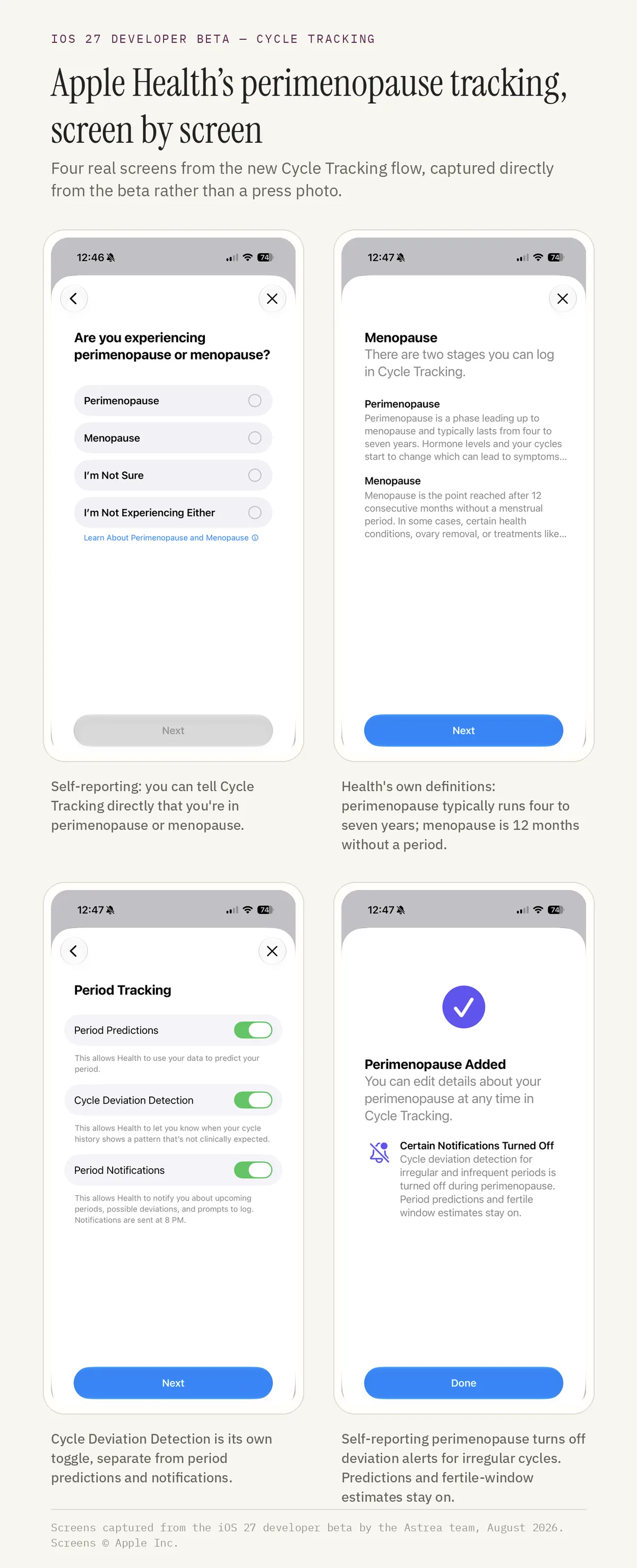
Cycle Tracking has existed on iPhone since 2019. What’s new in iOS 27 is that it now extends into perimenopause and menopause specifically. You can log that you’re in one of these stages, track symptoms like hot flashes, sleep disruption, or mood changes, and read new educational articles Apple built with clinical input.
The headline feature is automated: if the app sees a pattern in your logged cycles that looks like perimenopause, it can notify you. According to Apple clinician Dr. Lauren Cheung, that detection uses a six-month window of cycle data and criteria from FIGO, the Federation of International Gynecology and Obstetrics, for what counts as an irregular or infrequent cycle. Those same irregularity criteria can flag a deviation for a user of any age, but the notification only frames it as perimenopause for users 40 and over, because that’s the age range where an irregular cycle is more likely to actually be perimenopause rather than something else.
That age cutoff is worth understanding rather than just reading as a limitation. Perimenopause, medically, is a hormonal transition typically lasting four to seven years that ends twelve months after your final period (Harlow et al., 2012). It usually starts in the mid-forties but can begin in the late thirties. Apple’s own team acknowledges this. When asked directly why the alert doesn’t extend below 40, Dr. Cheung’s answer was that under 40, an irregular cycle is still worth a doctor’s visit, just not one Apple wants to auto-label without more certainty. If you’re in your late thirties and your cycles have shifted, the app not naming it for you doesn’t mean nothing is happening. It means Apple decided that call should stay with a clinician rather than a notification.
None of this requires an Apple Watch. Cycle Tracking runs on manual logging in Health on iPhone or iPad. If you do wear an Apple Watch, wrist temperature data can improve how accurately the app predicts your cycle and fertile window, but symptoms like night sweats still have to be logged by hand for now, and they’re not yet cross-referenced with your sleep data automatically.
Alongside the tracking update, Apple Fitness+ launched Strong Through Menopause, a nine-workout collection built around six strength sessions and three yoga classes, meant to be used as two strength workouts and one yoga flow per week. Per Apple’s fitness team, the programming was built around specific priorities for this life stage: pelvic floor activation, muscle maintenance, balance, and cardiovascular health, rather than the performance metrics most fitness content defaults to. Whether or not you use Apple’s own tools to track your cycle, that shift in what a workout program prioritizes for this stage of life is worth noticing.
Why this life stage has been an information gap for so long
Perimenopause affects roughly half the population and has historically gotten a fraction of the research funding and clinical attention that other life stages receive. That gap shows up in real clinical blind spots. The American Heart Association’s 2020 scientific statement found that the menopause transition itself, independent of normal aging, raises cardiovascular disease risk, with the increase in risk showing up about a decade earlier in women than the equivalent age-related rise in men (El Khoudary et al., 2020). A 2024 review in Maturitas found perimenopause is a genuine window of vulnerability for mood and anxiety disorders, tied to hormonal and psychological factors, not just to the stress of parenting or work that happens to coincide with this age (McElhany et al., 2024).
Millennials are the first generation reaching this stage having already spent two decades or more with a phone that logs steps, sleep, and cycles by default. Whether that’s a meaningful advantage depends on what you do with the data, but earlier generations of women had to reconstruct a pattern from memory at a doctor’s appointment. This generation can walk in with six months of logged cycle length, symptoms, and dates already in hand.
It also explains why the money is moving. One industry analysis puts the global market for menopause management platforms and hormone therapy at $4.85 billion in 2025, projecting nearly 19% annual growth through 2035, with AI-enabled personalized care apps singled out as the fastest-growing piece of it (SNS Insider, 2026). That’s after years where fertility and pregnancy tracking got most of the femtech attention and investment. When Apple builds something into the operating system itself, smaller, more specialized apps in this space get a signal too: there’s a real, growing user base here worth building for.
What to actually watch with your data
Cycle and symptom data is about as sensitive as health information gets, and it’s worth being deliberate about it rather than assuming an app’s default settings are the right ones for you. Apple’s own framing, from an interview with the team behind this update, is that health data is encrypted on-device when you have a passcode or biometric lock set, and encrypted in transit and on their servers if you use iCloud backup, so Apple itself can’t read it. Third-party apps only get access to specific data categories you approve, one category at a time, in Settings.
That’s a reasonable baseline, but it’s still worth checking periodically which apps you’ve granted access to and whether they still need it. A period-tracking app you tried once two years ago may still have standing permission to read your cycle history. Go to Settings, then Privacy & Security, then Health, and review the list. If you don’t recognize an app or don’t use it anymore, revoke access.
What to actually do
- If your cycles have felt off and you’re under 40, don’t wait for an automated label. Log at least three or four cycles of data yourself and bring it to your doctor rather than waiting for the app to name what’s happening.
- If you’re 40 or older, turn on Cycle Tracking and give it time. The detection window is six months, so a single irregular cycle won’t (and shouldn’t) trigger anything.
- Review your Health data permissions in Settings at least twice a year, and remove access for apps you no longer use.
- If strength training isn’t part of your routine, this is a well-supported moment to start. A systematic review of postmenopausal women found consistent, if moderate, improvements in bone mineral density from resistance training (Shojaa et al., 2020), and bone density loss accelerates during this transition.
- Read the new educational content in Health even if you never open Cycle Tracking day-to-day. It’s a low-effort way to understand what’s normal for this stage before you’re trying to figure it out mid-symptom.
FAQ
I’m 35 and think I might be perimenopausal. Will the Health app tell me? Not with the automated alert, that’s reserved for users 40 and older. You can still log symptoms and cycles manually at any age, and that log is useful to bring to a doctor even without an in-app notification.
Do I need an Apple Watch for any of this? No. Cycle Tracking, symptom logging, and the perimenopause alert all work from manual entries on iPhone or iPad. A Watch improves prediction accuracy through wrist temperature data, but it’s not required.
Is my cycle data actually private? Apple’s stated design encrypts this data on-device and, if you back up to iCloud with two-factor authentication on, in transit and on their servers too, meaning Apple says it cannot read the contents. Third-party apps only see what you specifically grant them, category by category. That’s a strong baseline, but it’s still worth auditing which apps have access on a regular basis.
Will this replace seeing a doctor? No, and Apple doesn’t present it that way. The alert is designed to prompt a conversation with your doctor, not to diagnose you. If you log bleeding after menopause, which isn’t normal, you’ll get a notification to see a doctor rather than any kind of self-diagnosis.
When does this actually roll out? Apple announced it at WWDC in June 2026, with availability planned for fall 2026 alongside iOS 27.
Sources
El Khoudary, S. R., Aggarwal, B., Beckie, T. M., Hodis, H. N., Johnson, A. E., Langer, R. D., Limacher, M. C., Manson, J. E., Stefanick, M. L., & Allison, M. A. (2020). Menopause transition and cardiovascular disease risk: Implications for timing of early prevention. A scientific statement from the American Heart Association. Circulation, 142(25), e506–e532. https://doi.org/10.1161/CIR.0000000000000912
Harlow, S. D., Gass, M., Hall, J. E., Lobo, R., Maki, P., Rebar, R. W., Sherman, S., Sluss, P. M., & de Villiers, T. J. (2012). Executive summary of the Stages of Reproductive Aging Workshop + 10: Addressing the unfinished agenda of staging reproductive aging. Journal of Clinical Endocrinology & Metabolism, 97(4), 1159–1168. https://doi.org/10.1210/jc.2011-3362
McElhany, K., Aggarwal, S., Wood, G., & Beauchamp, J. (2024). Protective and harmful social and psychological factors associated with mood and anxiety disorders in perimenopausal women: A narrative review. Maturitas, 190, 108118. https://doi.org/10.1016/j.maturitas.2024.108118
Shojaa, M., von Stengel, S., Kohl, M., Schoene, D., & Kemmler, W. (2020). Effect of exercise training on bone mineral density in post-menopausal women: A systematic review and meta-analysis of intervention studies. Frontiers in Physiology, 11, 652. https://doi.org/10.3389/fphys.2020.00652
Reporting, interviews, and market data. Quotes and product details attributed to Dr. Lauren Cheung, Director of Apple Health, and the market figures on menopause-focused digital health, are drawn from the following original reporting and industry research rather than peer-reviewed research:
Barasch, E. (2026, July 29). Apple will help you track your perimenopause symptoms. Spread the Jelly. https://spreadthejelly.com/articles/apple-health-cycle-tracking-perimenopause
McGuire, J. (2026, June 15). Exclusive: Can an Apple Watch actually spot perimenopause? I sat down with Apple to find out more about its new women’s health features. Tom’s Guide. https://www.tomsguide.com/wellness/fitness-trackers/exclusive-can-an-apple-watch-actually-spot-perimenopause-i-sat-down-with-apple-to-find-out-more-about-its-new-womens-health-features
SNS Insider. (2026, July 7). Menopause management platform & hormone therapy market size, share & global forecast 2026–2035 (Report No. SNS/HC/10550). https://www.snsinsider.com/reports/menopause-management-platform-and-hormone-therapy-market-10550
A note from us We’re Martin and Marina, Astrea’s co-founders. We’re both into data and serious about our own training, but neither of us is a doctor or a clinical researcher. The health and physiology claims in this article come from published, peer-reviewed research, not our own expertise, which is why every article ends with a Sources list above. If a claim doesn’t trace back to a real source, we cut it before it gets published.
Astrea reads the cycle you already track in Apple Health and shows you where today falls in it, right beside your numbers.